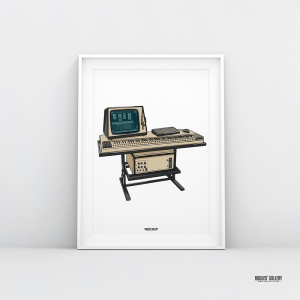
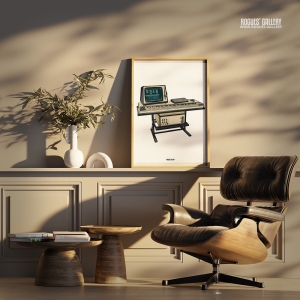
Fairlight CMI – The Machine That Changed Music Forever
Few instruments can genuinely claim to have changed the course of popular music. The Fairlight CMI is unquestionably one of them. Part synthesiser, part computer and part sonic laboratory, this extraordinary Australian invention helped define the sound of the 1980s and laid the foundations for modern digital music production.
Introduced in 1979 by Australian engineers Peter Vogel and Kim Ryrie, the Fairlight CMI — Computer Musical Instrument — represented a technological revolution. At a time when analogue synthesisers dominated electronic music, the Fairlight offered something astonishing: the ability to record real-world sounds digitally, manipulate them and play them melodically across a keyboard.
Suddenly, virtually anything could become a musical instrument.
Breaking glass, orchestral strings, human voices, industrial noises and exotic percussion could be captured, transformed and incorporated into compositions. Its distinctive computer terminal, light pen, keyboard and floppy disk drives made the Fairlight resemble something from a science-fiction laboratory rather than a conventional recording studio.
Early models offered eight-bit sampling and eight-note polyphony, producing a distinctive, slightly gritty digital character that became one of the defining sonic signatures of the decade.
The introduction of the groundbreaking Page R graphical sequencer brought another revolution, allowing musicians to construct complex rhythmic patterns and arrangements visually — anticipating the sequencing interfaces found in modern music software.
Unsurprisingly, the Fairlight attracted some of the most adventurous artists and producers in popular music.
Peter Gabriel was an early champion, experimenting with its possibilities on his groundbreaking 1980 album Peter Gabriel, commonly known as Melt. Kate Bush embraced the instrument enthusiastically, using its extraordinary capabilities on recordings including Babooshka, The Dreaming and the magnificent Hounds of Love.
Trevor Horn and his collaborators transformed the Fairlight into a formidable production weapon. Its unmistakable orchestral stabs featured on Yes's Owner of a Lonely Heart, while the Art of Noise pushed sampling into exciting new territory with pioneering recordings such as Close (to the Edit) and Moments in Love.
Its distinctive sounds also appeared on Tears for Fears' Shout, while artists including Jean-Michel Jarre, Stevie Wonder, Herbie Hancock and Brian Eno explored its creative possibilities.
Costing tens of thousands of pounds, the Fairlight was initially the preserve of elite recording studios and exceptionally successful musicians. Yet its influence extended far beyond those fortunate enough to own one.
Today, sampling, digital sequencing, waveform editing and computer-based composition are everyday features of music production. The Fairlight helped make that future possible.
A magnificent marriage of musical imagination and technological innovation, the Fairlight CMI was more than a synthesiser — it was a glimpse into the future. Its distinctive sounds helped define an era, while its revolutionary ideas changed music-making forever. A true icon of electronic music history.
LARGER SIZED PRINTS - A2, A1 and A0 - available in another listing!
Limited Edition of 250 A3 prints and just 20 of larger sizes.
A3 Size shipped in cardboard backed envelope. Larger sizes in rigid tubes.