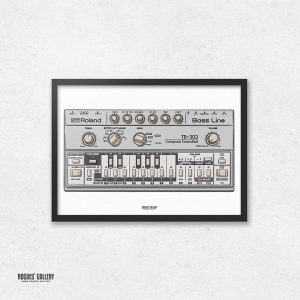
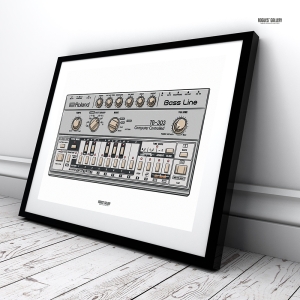
Roland TB-303 – The Little Silver Box That Invented Acid House
Few electronic instruments have enjoyed such an extraordinary journey from commercial failure to musical immortality as the Roland TB-303 Bass Line. Originally designed as a humble accompaniment for practising musicians, this unassuming little silver box accidentally helped invent acid house and transformed the sound of electronic dance music forever.
Introduced in 1982 by Japanese manufacturer Roland, the TB-303 was intended to simulate a bass guitarist, allowing solo musicians to practise alongside programmed bass lines. Paired with the equally modest TR-606 Drumatix drum machine, it promised an affordable electronic rhythm section.
Unfortunately, there was one rather significant problem: it sounded almost nothing like a real bass guitar.
Its peculiar, rubbery electronic tones and notoriously awkward programming system failed to impress its intended customers. Sales were disappointing, and Roland discontinued production in 1984, apparently consigning the instrument to the technological dustbin.
But the TB-303's greatest moment was still to come.
Beneath its modest exterior lay a remarkably distinctive monophonic analogue synthesiser, featuring a single oscillator, resonant low-pass filter and a built-in step sequencer. Its ingenious accent and slide functions allowed notes to squelch, glide, bubble and twist in ways that conventional bass instruments simply couldn't reproduce.
When adventurous Chicago musicians began experimenting with second-hand 303s during the mid-1980s, they discovered that manipulating the filter resonance and cutoff controls could produce extraordinary, hypnotic sounds.
The breakthrough came with Phuture, the pioneering Chicago trio featuring DJ Pierre, Spanky and Herb J. Their revolutionary recording Acid Tracks, released in 1987, unleashed the TB-303's gloriously squelching sound upon unsuspecting dance floors and helped establish an entirely new musical movement.
Acid house had arrived.
The instrument rapidly became a defining feature of underground club culture, particularly during Britain's late-1980s acid house explosion and the subsequent rave revolution.
Its unmistakable sound powered countless electronic classics, including Hardfloor's Acperience 1 and Josh Wink's Higher State of Consciousness, while generations of techno, house and electronic producers embraced its endlessly expressive possibilities.
The TB-303's influence extended far beyond acid house, inspiring artists across techno, trance, big beat and experimental electronic music. Its distinctive sonic character became synonymous with a period of extraordinary creativity and cultural change.
Ironically, the very instrument Roland had struggled to sell became a highly prized collector's item, with original examples commanding extraordinary prices. Numerous hardware clones, software recreations and Roland's own modern reinterpretations have kept its unmistakable sound alive.
A magnificent accident of musical history, the Roland TB-303 proved that commercial failure and creative genius can sometimes be separated by nothing more than a twist of a filter knob. From unwanted practice machine to the squelching heartbeat of acid house, this little silver box changed dance music forever.
LARGER SIZED PRINTS - A2, A1 and A0 - available in another listing!
Limited Edition of 250 A3 prints and just 20 of larger sizes.
A3 Size shipped in cardboard backed envelope. Larger sizes in rigid tubes.